
Opting Out
A brief literary history inspired by Alan Opts Out

I was lucky enough to read Courtney Maum’s new novel, Alan Opts Out, a couple of months before its release. It arrived at a perfect time for me, when I was slogging through the later stages of disengagement from a career that had, for a long time, been fruitful and satisfying but that began increasingly to interfere rather than align with who I wanted to be and what I wanted to do. I have come to borrow the novel’s distinct locution of “opting out” to describe my own experience because it feels right to me. I haven’t quit. I didn’t get fired. I’ve technically retired from a job but not from writing, which is work. I feel, at least a little bit, like Alan, without the milk or the cowboy or the mansion.1
Alan Anderson is a highly successful and well-to-do advertising executive who undergoes an unexpected crisis of faith in his profession and lifestyle. He moves into the playhouse, long since abandoned by his children, in the yard of his expensive home in the swankiest neighborhood of ultra-tony Greenwich, Connecticut—all while his wife pursues acceptance into the town’s most elite women’s club.
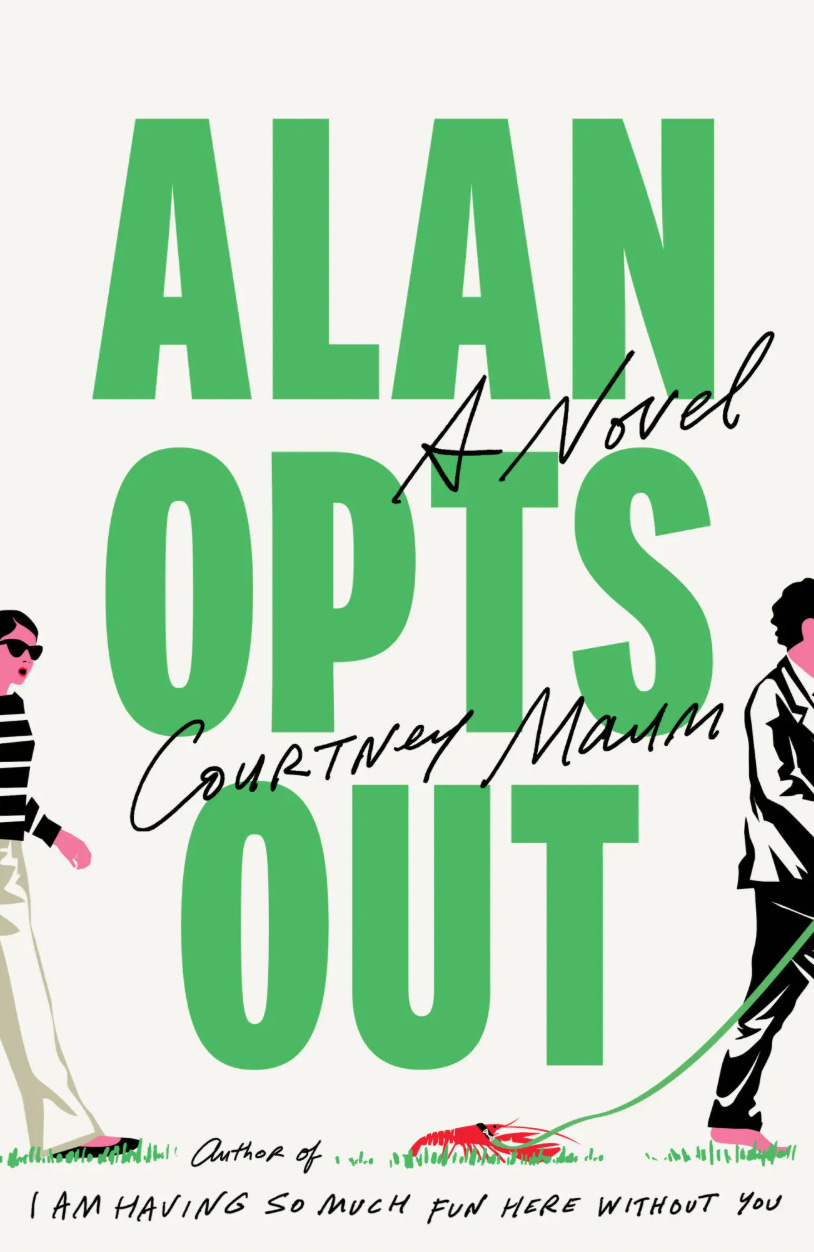
As I read, I couldn’t stop thinking about Henry David Thoreau’s Walden. Maybe it was the playhouse as a weird twist on the cabin. Maybe it was the proximity of Connecticut to Massachusetts.2 Or maybe it’s because I’ve spent the last 35 years of my life teaching and writing about American literature and find it hard to stop.
In any case, I kept picturing Alan as a version of Thoreau, time-traveling from his rugged nineteenth-century cabin in the woods to the highly manicured twenty-first-century backyard of someone like Kim Kardashian.3 Inside the mansion, a woman obsessively looks at herself in mirrors, real ones but also metaphorical ones, including screens and faces and comments by neighbors and celebrities and social media posters whose cues and responses tell her what’s acceptable, what to strive for, who to be, what to buy. She is committed to a project of fine-tuning her self to conform to social expectations, no matter how demanding or absurd, never wondering about the value or cost of those expectations.
Meanwhile, out in the yard, a man with a burgeoning neck beard spends the better part of his days counting nails and watching ants crawl across a windowsill. That last sentence describes Henry in the cabin, not Alan in the playhouse (whose preferences run to fishing poles and lobsters), but the point is the equivalency. Maybe that’s because Henry David Thoreau is the OG opt-outer, the inspirational predecessor to Into the Wild’s Chris McCandless and countless other writers and activists and dreamers who, across the centuries and on scales both massive and tiny, rejected the expectations of dominant society to live another kind of life, one opposed to greed and selfishness but also to conformity.
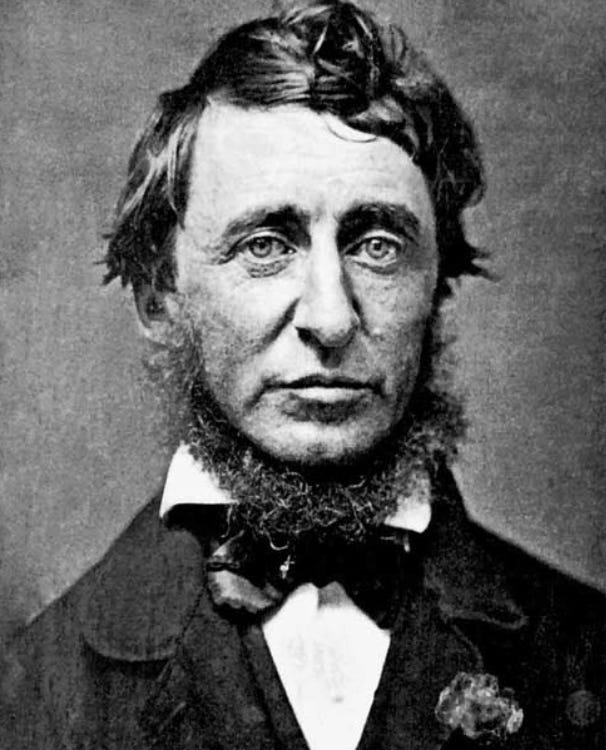
I’m nominating Alan Opts Out as the comedic literary heir to the deeply earnest tradition of transcendentalism, a movement that flourished two centuries ago in New England. Thoreau was one of its central figures, along with his Concord, Massachusetts friend and neighbor, Ralph Waldo Emerson. Emerson had been a Unitarian minister who resigned his post because it began to feel to him like an increasingly empty performance of rituals. He felt closer to God, he explained, while walking through the woods than he did sitting in a pew. So he opted out.
Emerson also wrote many essays, like “Nature” and “Self-Reliance,” that espoused a vision opposed to the rampant materialism, crass consumerism, and empty conformity he saw infecting and destroying American society in the 1840s. He also went on speaking tours where he shared these ideas. The talks and essays alike inspired many to establish or join intentional alternative communities—like Brook Farm (where Nathaniel Hawthorne lived for a time) and Fruitlands (begun by Louisa May Alcott’s father Bronson)—that aimed to carry out transcendentalist practices on a broader scale. These folks, too, were opting out, collectively (as opposed to Thoreau’s pond-side commune of one). They were all also opting in—to the conviction that a better world was possible.
Here’s the thing about self-reliance that Emerson recognized: if you’re opting out because everyone else is opting out, you’re not actually opting out. You’re fitting in. Which, according to Thoreau and other transcendentalists, is the problem. If you’re wearing a neck beard because neck beards are in, you’re not being authentic. If you have a pet lobster because everyone on Facebook is getting a pet lobster, you have a little mind bedeviled by hobgoblins.
Emerson is the king of aphorisms and one of his best is this knockout of a sentence: “A foolish consistency is the hobgoblin of little minds.” There’s the jab punch of the hobgoblin, which is a hard word to stop saying (in addition to being an annoying and misery-making prankster). Then there’s the sharp series of hits knocking those little minds, already weakened by a foolish belief in consistency, to the deck. As the Emerson devotee Walt Whitman would famously proclaim, there is nothing wrong with changing your mind or, for that matter, being of two (or more) minds.4
It’s always been easy and tempting to make fun of these communes and their inhabitants, which did include the occasional vegetarian, nudist, and perfectionist, as well as chauvinists, swindlers, and dreamers. But laughing at them is a way to avoid admiring both their risk-taking and their belief in the human capacity to make a better world. That kind of utopianism is deserving of our attention and our seriousness, even our love. The last time America made a serious run at utopianism was the early 1970s in communes like Drop City and Ant Farm. Maybe we’re due for a reprise of hope and conviction, of non-conformity and anti-materialism.

Despite being both fun and funny, one of my favorite things about Maum’s novel is its refusal to make fun of Alan (or, for that matter, of Vivian, his wife). This is a book that takes opting out seriously. Look out the window, Maum encourages us. Look inside yourself. What do you see?
In my case, there might actually be a cowgirl involved, but that’s another story.
Shout out to the novel’s setting in Connecticut, an overlooked and under-appreciated literary state if you ask me. At one point in my professional career I thought I might end up teaching in Connecticut and vowed, if I did, that I would develop a course on Connecticut literature that started with the Puritan minister Thomas Hooker and ended with Ang Lee’s film adaptation of Rick Moody’s The Ice Storm. Today it would need to end instead with Ocean Vuong and Maum. I am gifting this syllabus idea to the three or four people (possibly an overestimation) on the internet who might appreciate it.
To be fair, this is really not a good comparison to Vivian, Alan’s wife, who is far more complex than this pairing suggests, but I’m having trouble coming up with a better parallel. Suggestions welcome!
He put it this way, though: “Do I contradict myself? Very well then I contradict myself. (I am large, I contain multitudes).”
The pet lobster thing totally diverted me and I discovered that people are adopting what we call yabbies and you in the US call Australian red claw crayfish. I had a pet one in the 90s that I rescued from a fishmonger and called Dead Elvis. He would impale his goldfish friends at night and eat them. You have also convinced me to go buy this book.
"Beware of all enterprises that require new clothes."--Henry David Thoreau.
"Beware of all enterprises that require deodorant." Alan Anderson/ Courtney Maum
"The scent of these arm-pits [is an] aroma finer than prayer." -- Walt Whitman
Totally seeing the lineage here Michelle! Wonderful piece!